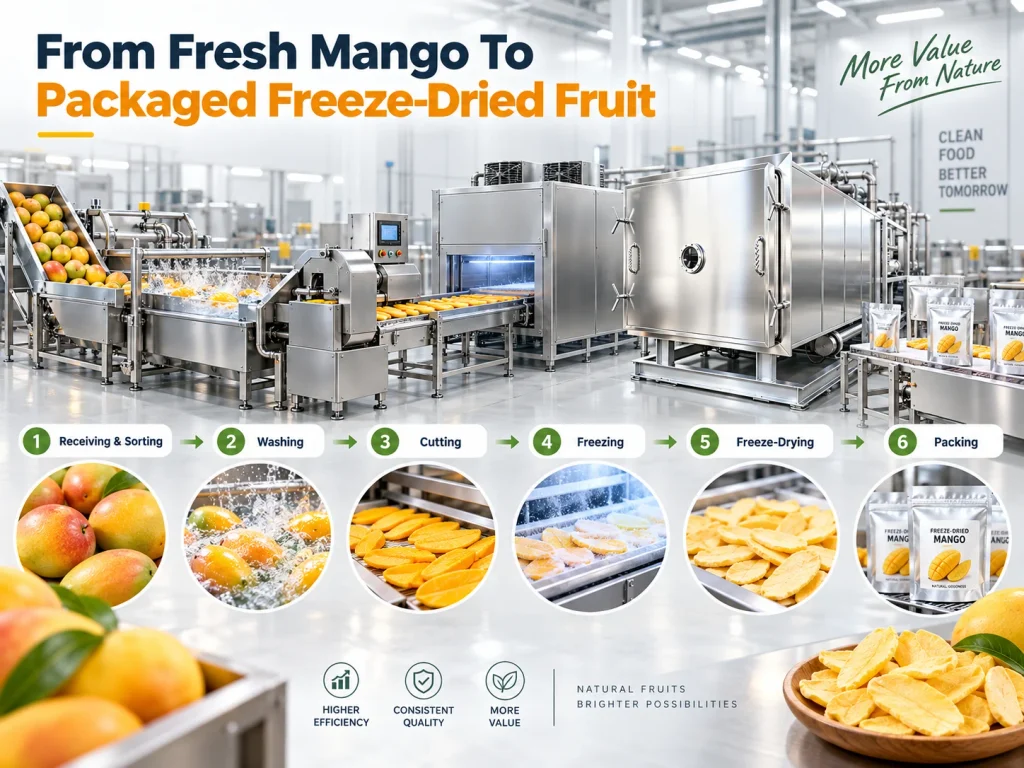
A mango arrives at the factory gate with high moisture, delicate flesh, and a short shelf life. It leaves as a crisp freeze-dried slice with months of shelf stability. The distance between those two states is a chain of machines. Smooth handovers between them decide the plant's daily output. A well-arranged freeze-dried fruit production line turns fresh mango into packaged product with fewer pauses and steadier output.
Where the Line Loses Time First
In practice, most lost hours hide at the connections between machines. Mangoes pile up before washing, washed fruit waits for the cutter, and trays queue at the freezer. Each pause adds handling, and each handling pass bruises soft tropical fruit. So the first job is to look at the flow, station by station.
Start With Gentle Washing
Washing quality decides how much rework the line faces later. An industrial bubble washing machine uses bubbles and circulating water to lift dirt and residue off mango skins. Gentle bubbling also protects ripe flesh from impact damage. Clean fruit then moves straight to the cutting station by conveyor.
Cut Pieces to a Drying-Ready Size
Cutting shapes both drying speed and the final look of the product. A commercial vegetable slicing machine cuts mango into even slices or dices at line speed. Even pieces then lose moisture at the same rate, so every tray finishes together. Mixed sizes instead stretch the cycle, because small pieces overdry while large ones stay wet. Steady cutting output also keeps trays filling at an even pace.
Pre-Freeze Fruit Before the Chamber
Freezing locks the structure that sublimation needs. An industrial tunnel freezing machine freezes trays fast in a continuous flow, so the loading station never waits. The freezer then runs in step with chamber unloading, and frozen fruit moves straight to loading. Meanwhile, product stays below the melting point, so texture and color survive intact. Trays come out firm to the touch and go straight into the chamber as well.
Run Drying and Packing as One Rhythm
Inside the chamber, the freeze dryer turns ice into vapor under vacuum. Fruit leaves the chamber dry and brittle, and it absorbs moisture quickly in open air. Therefore, packing must follow unloading without delay. A short transfer path and ready packaging materials keep exposure minutes low. In short, the last ten meters of the line protect everything the previous stations achieved.
Build the Line as One System
The most reliable way to raise efficiency is to design all stations together from the start. Hadof builds freeze-dried fruit production lines around your raw material, target output, and factory floor. Washing, cutting, freezing, drying, and packing capacity then stay balanced, so no station races ahead or falls behind. Each machine arrives matched to the stations beside it, instead of chosen one by one. To discuss a customized fruit freeze-drying solution, visit the Hadof freeze dryer homepage at https://www.freezehadof.com/.