When you plan an NPK fertilizer project, granulation technology can influence far more than the shape of your final granules. It can affect your production capacity, raw material flexibility, drying demand, plant layout, operating rhythm, and future expansion. Rotary drum and disc granulation are both practical choices, but which one fits your project better?
Instead of comparing the two machines alone, you can look at how each granulation method fits your complete production plan.
How Does a Rotary Drum Granulator Fit Your Production Scale?
Are you planning continuous NPK fertilizer production with relatively high output? A rotary drum granulator can give you more room to build a continuous processing route.
Raw materials enter the rotating drum after batching and mixing. As the drum rotates, the materials roll, collide, and gradually form granules with the help of controlled moisture or binder addition.
This approach fits well when you are considering a turnkey NPK fertilizer production line that connects batching, mixing, granulation, drying, cooling, screening, coating, and packaging.
The drum structure also allows you to handle a relatively large material flow. Therefore, it can be attractive when your project focuses on stable continuous production and future capacity expansion.
When Can Disc Granulation Be a Better Choice?
What if your planned capacity is smaller or you want greater visual control over the granulation process?
A disc granulator uses an inclined rotating pan. You can adjust the disc angle, rotation speed, moisture addition, and feeding conditions to influence granule formation.
This structure can make operation relatively intuitive, especially when you want to observe material movement during production. It can also fit compact fertilizer projects where equipment investment and plant footprint receive more attention.
However, disc granulation and an NPK fertilizer dry granulation line represent different processing concepts. Your raw material characteristics and desired granulation method can help you decide which route offers a better match.
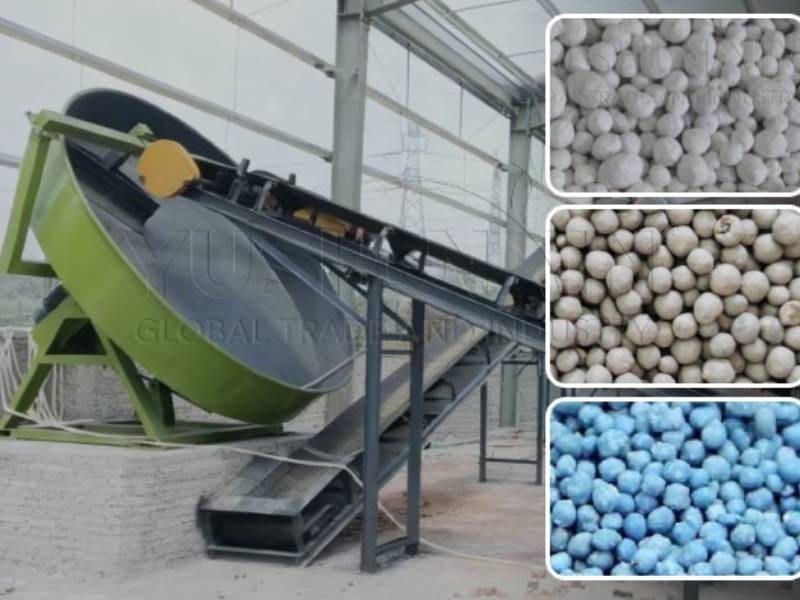
Which System Requires More Supporting Equipment?
Your granulator rarely works alone. After wet granulation, your process may include drying, cooling, screening, recycling, coating, conveying, dust collection, and packaging.
This is why comparing an NPK fertilizer plant equipment list can give you a clearer picture than comparing granulator prices alone.
Rotary drum granulation often works naturally with larger continuous drying and cooling systems. Disc granulation can support a simpler arrangement for smaller projects, although your actual configuration still depends on capacity and final fertilizer specifications.
How Can You Choose Between Rotary Drum and Disc Granulation?
Start with your raw materials, expected output, fertilizer formula, granule size, available site, energy conditions, and automation goals.
If your market also places importance on equipment documentation and conformity, you may include a CE certified NPK fertilizer production line in your supplier evaluation criteria.
For higher-capacity continuous projects, rotary drum granulation can offer a strong direction. For smaller or more flexible operations, disc granulation may give you a simpler entry point.
Plan the Complete Plant Before Choosing the Granulator
The better choice becomes clearer when you place the granulator inside the whole production process. A well-developed fertilizer production plant design can connect equipment selection with your capacity, site conditions, utilities, material flow, and finished fertilizer goals.
Rather than asking which granulator is universally better, you can ask which one creates a more practical production route for your project.
Click here for more details about equipment configurations and NPK fertilizer granulation solutions.Or you can visit:https://www.shunxin.eu/npk-fertilizer-production-line/