The vacuum pump is one of the most important systems in an industrial freeze dryer, yet it is often treated as a component selected only by the machine manufacturer. In practice, pump performance directly affects chamber pressure, sublimation rate, cycle length, energy use, and batch consistency. A strong refrigeration system cannot compensate for a vacuum system that removes gas too slowly or allows pressure to rise during drying.
This guide explains what the vacuum pump does, how it interacts with the cold trap and product load, and which checks help food factories maintain stable freeze-drying performance.
What the Vacuum Pump Does in Freeze Drying
During primary drying, water leaves the frozen product as vapour and is captured by the cold trap. The vacuum pump removes non-condensable gases and helps establish the low-pressure environment needed to support sublimation. The pump and cold trap therefore perform different jobs. The cold trap captures water vapour, while the pump removes gases that the trap cannot condense.
Chamber pressure influences the balance between heat input and water-vapour removal. If pressure is too high, drying can slow and heat transfer may become less predictable. If the system tries to operate at an unsuitable pressure, the product may receive too much energy or the cold trap may become overloaded.
The three-stage freeze-drying process depends on coordinated freezing, vacuum, heating, and condensation. The pump is not a standalone guarantee of quality. It must be matched to the chamber volume, maximum vapour load, cold-trap condition, leakage rate, and the process pressure used for each product.
Why Ultimate Vacuum Is Not the Only Selection Number
A pump's ultimate pressure describes the lowest pressure it may reach under defined conditions. That number does not prove the pump has enough capacity to handle a production load. Freeze dryers operate over a pressure range influenced by product temperature, ice load, heating rate, and condenser temperature.
Pump selection should consider four values together:
- Pumping speed at the intended operating pressure
- Maximum allowable inlet pressure and vapour load
- Ultimate pressure of the complete vacuum system
- Available cooling, utilities, and service requirements
The chamber and piping also affect performance. A high-capacity pump cannot overcome a restrictive connection, leaking door seal, contaminated cold trap, or unstable pressure sensor. Buyers should request system-level performance data rather than comparing a pump datasheet in isolation.
Common Vacuum Pump Configurations
Food freeze dryers commonly use oil-sealed rotary-vane pumps or dry pump combinations. A rotary-vane pump can provide strong vacuum performance, but oil condition is critical. Water vapour, condensable gases, and process contamination can degrade the oil and reduce performance if the cold trap and operating procedure are not controlled.
Dry screw or dry pumping combinations avoid oil contamination risk and may reduce maintenance complexity, but they can require different capital, cooling, and service planning. Roots blowers may be combined with a backing pump where higher pumping speed is needed, but the control sequence and pressure limits must be engineered correctly.
The best choice depends on the product and plant. Large food systems handling high moisture loads will not have the same requirements as a small pilot dryer processing low-moisture ingredients. Energy use, spare parts, service access, and local technical support should be assessed alongside vacuum performance.
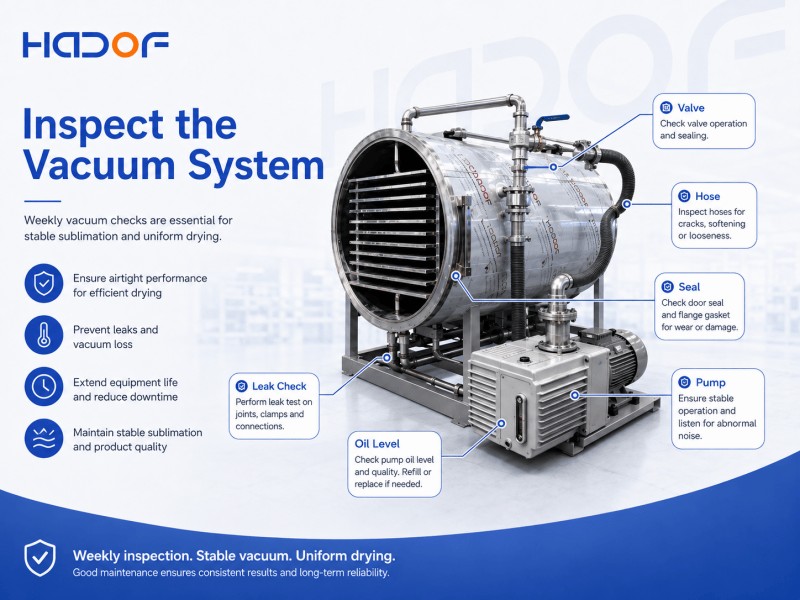
Inspect The Vacuum System of food freeze dryer
Signs That Vacuum Performance Is Limiting Production
Operators may not notice a gradual decline immediately because the controls can sometimes compensate elsewhere. Warning signs include longer pump-down time, higher chamber pressure at the same recipe, slower primary drying, increased shelf temperature, and difficulty reaching the final moisture target.
Other symptoms include:
- Pressure rising too quickly during a rate-of-rise or leak test
- Frequent gas-ballast use or excessive pump exhaust moisture
- Unstable vacuum readings during the drying plateau
- Pump overheating, abnormal noise, or vibration
- Increasing cycle time without a raw-material change
Not every pressure problem comes from the pump. Inspect the chamber seal, sensor calibration, valve position, cold-trap ice load, piping, and product loading first. Replacing the pump is not an appropriate response to a leaking door, a wet cold trap, or a faulty gauge.
Match Pump Capacity to the Batch and Cold Trap
The rate of sublimation changes through the cycle. Early primary drying can produce a high vapour load, while later stages release less moisture. The vacuum system and cold trap must work together across that changing load, not only at the final pressure.
Pump capacity should be calculated with input from the dryer designer using chamber volume, expected gas load, leak rate, cold-trap temperature, and the product recipe. Food factories should review this when increasing tray loading, changing cut size, processing wetter materials, or pushing shorter cycle times. These changes may exceed the original vacuum envelope even when the batch weight remains the same.
An industrial freeze dryer should be commissioned as a complete system. Record baseline pump-down time, working pressure, leak rate, and pressure stability for each standard recipe so later changes can be compared with known performance.
Commissioning and Routine Checks
After installation, perform a leak test and compare pump-down performance with the approved commissioning record. Confirm that pressure instruments are calibrated and that the control system uses the correct units and sensor range. Verify valve sequencing and ensure the pump is isolated from the chamber when required by the manufacturer's procedure.
During production, record pressure at defined points in the cycle rather than a single end value. A trend chart can reveal gradual decline before it becomes a failed batch. Scheduled checks may include oil condition where applicable, filters, seals, cooling flow, exhaust condition, vibration, and alarm history.
Pump maintenance intervals must follow the manufacturer's instructions and the actual duty. A dusty environment, high moisture load, frequent large batches, or poor cooling may justify more frequent inspection. Record every change so the maintenance team can distinguish normal wear from a process problem.
Operating Practices That Protect the Vacuum System
Start from the approved sequence instead of opening every valve at once. Follow the manufacturer's warm-up and isolation procedure, and confirm the cold trap is ready before releasing a high vapour load. Avoid unnecessary air admission into a cold system because it adds moisture and non-condensable gas that the pump must handle.
Tray loading, freeze quality, and drying temperature still matter. Poor freezing can produce large or uneven ice crystals, and excessive tray depth can create a heavier vapour load than expected. Operators should investigate these variables when vacuum pressure becomes unstable.
For larger plants, a complete freeze-drying production line should include space for vacuum-system service access and a plan for exchanging or repairing critical components. Downtime can be more expensive than the pump itself if the factory has no spare parts, trained technicians, or documented recovery procedure.
Practical Selection Checklist
- Define the product, batch size, moisture content, and tray loading
- Confirm the required process pressure range with the dryer supplier
- Check pumping speed at the operating pressure, not only ultimate vacuum
- Review cold-trap capacity and maximum water-vapour load together
- Verify chamber leakage, piping, valve, and sensor requirements
- Confirm utility consumption, cooling, noise, and service access
- Ask for commissioning data, maintenance intervals, and critical spares
- Train operators to trend pressure and respond to abnormal alarms
A 100kg/batch industrial freeze-drying plant shows why the vacuum system must be planned as part of the full process. Capacity, product quality, and serviceability all depend on a correctly integrated system.
For help selecting the right vacuum performance, capacity, and support package for a food freeze-drying project, contact HADOF Food Processing Manufacture with your raw material, batch size, product target, and available utilities.