A 100kg/batch industrial freeze-drying plant is one of the most common starting points for commercial food producers. It is large enough to supply retail and ingredient customers, but manageable enough to fit a mid-sized factory and a realistic budget. Setting one up well — rather than simply buying a dryer — is what determines whether the plant runs smoothly and profitably. This guide walks through the steps, from product planning to commissioning.
What a 100kg/Batch Plant Includes
A complete plant is more than a freeze dryer. It usually includes pre-processing equipment (washing, cutting, blanching), a pre-freezer, the 100kg/batch industrial freeze-drying plant itself, and packaging equipment. Utilities, drainage, and a controlled production area are just as important as the machines, because the plant has to run consistently day after day.
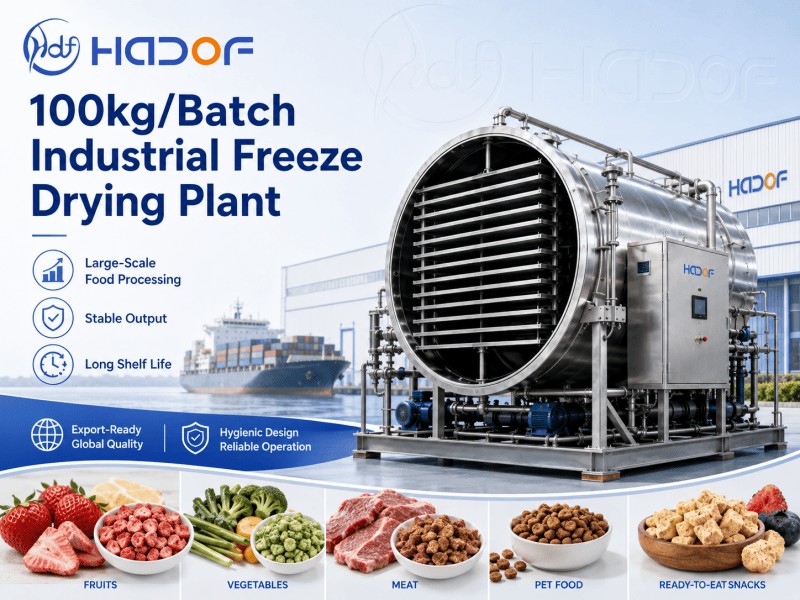
100kgbatch industrial Freeze Drying Plant
Step 1: Define Products and Capacity
Start with the product. Fruit, vegetables, meat, seafood, and prepared foods all behave differently during freezing and drying, and the plant layout should follow the product you intend to make. Define your target output, your product formats, and your packaging. A 100kg batch per cycle is a useful benchmark, but the daily output depends on the drying cycle length and how many shifts you run.
Step 2: Plan the Building and Utilities
The building needs enough space for raw-material receiving, preparation, drying, and packaging, with a clear flow that avoids cross-contamination. Power capacity matters, because refrigeration and vacuum systems draw significant load. Water supply and drainage are needed for washing and cleaning, and the floor should be able to handle wet areas. Planning these details early avoids expensive changes later.
Step 3: Choose the Freeze Dryer and Supporting Equipment
The core of the plant is the industrial freeze dryer, sized to the 100kg batch and the product's drying behavior. Around it, you need a pre-freezer or tunnel freezer, preparation equipment, and a packing machine. The dryer's chamber, shelves, condenser, and vacuum system determine cycle time and consistency, so it is worth specifying them carefully rather than choosing on price alone.
Step 4: Design Pre-Processing and Post-Processing
Pre-processing has a large effect on quality. Washing, cutting, and blanching prepare the product and stabilize its color and texture. Post-processing — sorting, metal detection, and packaging — protects the finished product. The freeze-drying process should be designed together with these steps, because a problem upstream shows up in the dryer and a problem downstream ruins the final product.
Sizing and Layout
Sizing is more than matching the dryer to a batch weight. The building, the pre-freezer, and the packing line all need to keep pace with the dryer's cycle. A common mistake is to size the dryer correctly but leave too little space for raw-material staging, tray loading, and finished-product packing. Layout should follow the process flow — receiving, preparation, freezing, drying, packing — with clear aisles for movement and enough room for cleaning. A simple paper layout reviewed with the equipment supplier can catch many problems before installation begins.
Step 5: Install, Commission, and Train
Installation is not finished when the machines are in place. The plant needs commissioning: testing the refrigeration, vacuum, and control systems, running trial batches, and confirming that the product meets specification. Operator training matters too, because the people running the plant need to understand the freezing, drying, and packaging stages. A good supplier supports this phase with documentation and on-site guidance.
Step 6: Build Quality and Food Safety Systems
A 100kg plant producing food should have basic quality and food-safety systems in place. Batch records should link raw materials, process parameters, and packaging lots. Cleaning routines, pest control, and traceability should be planned from the start. If you plan to export, check the standards your target markets require before the plant is built, because some requirements affect the layout and equipment.
Commissioning Checklist
A useful commissioning checklist covers the utilities, the equipment, and the product. Confirm the power supply and cooling capacity, test the vacuum and refrigeration systems, and run a full drying cycle with a representative product. Check that the control system logs pressure, shelf temperature, and cycle time, and that the operator can access and understand the data. Run at least two or three trial batches so the team can see the variability and adjust the recipe. Only after the product meets specification should the plant move into regular production.
Cost and Timeline
The total investment depends on the product, the level of automation, and the condition of the building. Beyond the equipment, budget for installation, electrical work, water and drainage, and operator training. A realistic timeline includes design, procurement, installation, commissioning, and trial production. Trying to compress the schedule often leads to shortcuts that cost more later.
Common Mistakes to Avoid
The most common mistake is buying the dryer before defining the product and the process. The second is under-sizing utilities, especially power and cooling. The third is ignoring the building layout, which makes material handling inefficient. The fourth is skipping commissioning and trial batches, so problems only appear in full production. Finally, treating quality and food safety as an afterthought makes it much harder to meet customer and export requirements.
Conclusion
Setting up a 100kg/batch industrial freeze-drying plant is a manageable project when it is planned around the product, the building, and the process. The plant is a system — preparation, freezing, drying, and packaging must all work together. HADOF Food Processing Manufacture designs complete production lines around its freeze dryers and supports customers from layout planning to commissioning. Tell us your product and target output, and we will help you plan the right plant.